
Key Takeaways:
- Stem wall inspection in Phoenix requires specialized knowledge of Arizona’s extreme climate, expansive soil, and thermal cycling — standard concrete patching rarely addresses the underlying causes.
- Qualified professionals, like James Belville of Concrete Repairman LLC (ROC 300512), can distinguish between cosmetic surface damage and true structural compromise — a distinction that protects your home’s long-term value.
- Before hiring any contractor for stem wall repair, ask them to explain why they’re recommending a specific method — a true expert can teach you, not just sell you.
Your home sits on a hidden structural layer most homeowners never think about — until something goes wrong.
The stem wall is the critical band of concrete that connects your foundation to the walls above. In Phoenix, Chandler, Scottsdale, Tempe, and across Maricopa County, stem walls endure some of the harshest conditions of any building component. Heat, drought, monsoon saturation, and Arizona’s notorious expansive soils all converge on this single structural element.
A thorough stem wall inspection is not just a line item on a contractor’s checklist. It is, as James Belville of Concrete Repairman LLC (ROC 300512) teaches contractors nationwide, the starting point for every sound structural decision. Understanding what qualified professionals look for — and why — puts you in a far stronger position as a homeowner.
CALL (602) 418-2970
FOR IMMEDIATE FOUNDATION REPAIR
CALL 480-725-7614 FOR IMMEDIATE FOUNDATION REPAIR
Understanding Stem Wall Function in Phoenix Construction
Before any stem wall inspection makes sense, you need to understand what the stem wall actually does.
In residential construction, the stem wall acts as the vertical transition between your slab or footing and the framed structure above. It distributes the load of your home’s walls, roof, and contents down into the foundation system. Furthermore, it creates a physical barrier between soil moisture and your living space.
Phoenix construction relies heavily on stem walls because of the behavior of Arizona’s expansive clay soils. These soils swell when wet and shrink when dry. That constant movement — repeated across every monsoon season and every dry stretch — creates cumulative stress on anything anchored to the ground.
According to the American Concrete Institute, concrete is strong under compression but vulnerable to tensile stress and moisture infiltration. Arizona’s wet-dry cycles apply both. That combination explains why stem wall repair is not simply a cosmetic issue in the Phoenix region.
A qualified stem wall inspection evaluates the wall’s load-path continuity, rebar condition, concrete carbonation depth, and moisture-exposure history — not just visible surface cracks. James Belville, a third-generation master in stem wall restoration with teaching credentials through distributors nationwide, has spent his career demonstrating that most stem wall failures are predictable long before they become structural emergencies.
If you are researching foundation issues on your Phoenix property, understanding the role of the stem wall is the first step.
Identifying Stem Wall Problems Before They Become Structural Issues
Most Phoenix homeowners notice something is wrong with their stem wall through visible symptoms. However, visible damage is often a late-stage signal.
Early indicators that warrant a professional stem wall inspection include:
- Hairline cracks running horizontally or at 45-degree angles along the concrete surface
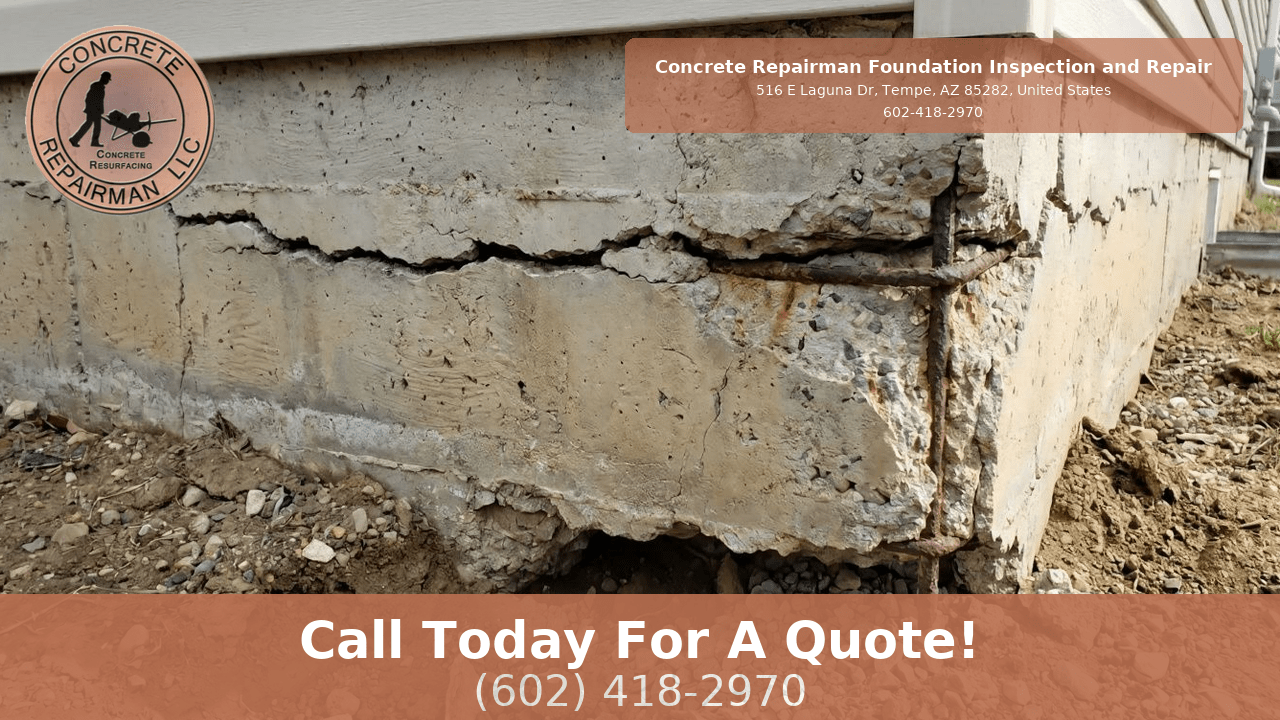
- Rust staining bleeding through the concrete, which signals that the embedded rebar is corroding beneath the surface
- Spalling, where the concrete surface flakes or chips away in irregular patches
- Efflorescence, the white mineral deposits left behind when water migrates through the concrete and evaporates
Each of these signs tells a different story about what is happening inside the wall. For example, rust stains combined with spalling typically indicate that moisture has reached the rebar, causing oxidation and the resulting expansion that physically fractures the surrounding concrete from within.
A surface patch applied over rust staining without treating the rebar is, as James Belville consistently teaches in his contractor training, a temporary cosmetic fix that accelerates the underlying failure. The repair traps moisture while the corrosion continues unabated beneath.
Homeowners in Mesa, Tempe, and Chandler frequently contact Concrete Repairman LLC after noticing these symptoms during routine yard maintenance or home sale inspections. The sooner a stem wall inspection is conducted, the more restoration options remain available.
Additionally, pest activity — particularly termite tubes traveling up through cracks in the stem wall — can indicate structural voids that compromise both pest barriers and concrete integrity.
Restoration Versus Replacement: The Master Craftsman Decision Process
One of the most consequential decisions in stem wall repair is whether to restore the existing structure or replace it entirely. This decision should never be made based solely on surface appearance.
James Belville’s approach, developed over more than 30 years and shared with contractors through distributor training programs across the country, centers on a systematic structural assessment before making any recommendation. Several factors inform that assessment:
- Depth of carbonation: Concrete naturally undergoes carbonation — a chemical process that lowers its pH over time. When carbonation reaches the rebar, it breaks down the passive oxide layer that protects the steel from corrosion. Testing carbonation depth reveals how much of the wall’s protective chemistry remains intact.
- Rebar section loss: If corroded rebar has lost significant cross-sectional area, the wall’s tensile capacity is compromised regardless of its surface appearance.
- Crack pattern and origin: Settlement cracks, shrinkage cracks, and load-induced cracks have distinct causes, trajectories, and repair protocols. Treating them identically is a diagnostic error.
- Moisture intrusion history: In Phoenix’s climate, moisture infiltration during the monsoon season followed by rapid drying creates cyclical damage that compounds annually. Understanding that history shapes the repair strategy.
Restoration, when appropriate, preserves existing sound concrete and reinforcing steel, extends the structure’s service life, and is typically more cost-effective than full replacement. Replacement is warranted when the structural integrity is compromised beyond what restoration chemistry can address.
Neither answer is universally correct. The right answer depends on a comprehensive stem wall inspection by someone who can correctly interpret the evidence. Learn more about our stem wall repair process to understand how this evaluation unfolds in practice.
Phoenix Climate Impact: Why Local Expertise Matters in Stem Wall Inspection
Phoenix’s climate is genuinely extreme by construction standards. Summer surface temperatures regularly exceed what most concrete mix designs were tested against. Monsoon moisture arrives suddenly and intensely, then disappears for months. Soil movement from these wet-dry cycles is measurable.
The Portland Cement Association identifies thermal cycling as one of the primary stressors that degrade concrete over time. In Phoenix, that thermal cycling is aggressive — temperatures can shift dramatically between night and day, especially in spring and fall. Each cycle creates microscopic expansion and contraction in the concrete matrix.
For stem walls, these stresses concentrate at points of existing weakness: old cracks, rebar penetrations, form tie holes, and cold joints from the original pour. A stem wall inspection performed by a contractor unfamiliar with Phoenix’s specific conditions may miss these concentrated stress points entirely.
Local knowledge matters in a second, practical way: product selection. Not every repair material performs the same in high-heat, low-humidity environments. Certain polymer-modified mortars, crystalline waterproofing systems, and corrosion-inhibiting coatings are specifically suited to desert conditions. James Belville’s training through distributor networks covers this material science in depth — because understanding why a product works in Phoenix’s environment is what separates a durable repair from a failed one.
For homeowners in Scottsdale, Mesa, and across Maricopa County, working with a contractor who holds an active Arizona ROC license (Concrete Repairman LLC, ROC 300512) provides both legal protection and a baseline assurance of local code knowledge. Verify your contractor’s license status before any structural work begins.
The Teaching Standard: Can Your Contractor Explain the Why Behind Their Stem Wall Inspection?
Here is a practical filter for evaluating any contractor you are considering for stem wall inspection or repair: ask them to explain why they are recommending a specific course of action.
A contractor who can only tell you what they will do — without explaining why — is operating from habit or price, not from structural understanding. A contractor who can explain diagnostic reasoning, material chemistry, and long-term performance expectations demonstrates genuine expertise.
James Belville has built his professional identity around this teaching standard. His work educating other contractors through distributor training programs across the country reflects a core belief: when professionals understand the underlying science, they make better decisions for homeowners. That same standard applies when a homeowner asks questions directly.
Expect your contractor to explain:
- What specific damage mechanisms are present in your stem wall
- Why does the proposed repair method address those mechanisms
- What is the expected service life of the repair under Phoenix conditions
- What maintenance, if any, does the repair require going forward
If those answers are vague, that is informative. Schedule a stem wall inspection with a professional who can confidently and specifically answer every one of those questions.
Structural decisions are long-term decisions. Your home in Phoenix, Chandler, Tempe, or anywhere in Maricopa County deserves the same standard James Belville holds every contractor to in his training programs: understand the why, then act on the evidence.
Frequently Asked Questions About Stem Wall Inspection
About the Owner: James Belville

Concrete Repairman LLC Owner James Belville is a third-generation master concrete foundation repair expert. James has extensive industry experience that includes concrete repair and Commercial and residential concrete foundation installations.
James teaches high school and college students how to finish concrete with confidence through several distributors nationwide and has appeared on the television show “The Concrete Cowboy” multiple times. With over 30 years of hands-on experience, James is skilled in the art of finishing concrete.
James Belville’s unmatched local experience means he can recognize the telltale signs of foundation problems without performing any expensive engineering calculations or analysis. James can readily identify expansive clay soil and other structural issues that could cause catastrophic building failure. This experience-based talent can save you tens of thousands of dollars.
