


Which Way Is It Moving?
Guidelines for Diagnosing Heave, Subsidence and Settlement
Ron Kelm, P.E. | Nicole Wylie, P.E. | Forensic Engineers Inc. | Houston TX | www.forensicengineersinc.com
OTHER TYPES OF MOVEMENT
There are other less common types of foundation movement occurring in the Houston area of which the forensic engineer should be aware. Though they are outside the scope of this paper, we will briefly cover active fault slippage and root heave, two movement types we have found in our work.
There are more than 350 known active faults in the Houston area, although only about one-third of these are well documented. Hundreds of structures have been built across fault lines, often inadvertently. The following photo is an example of a road and house in the Spring Branch area built across a fault line.
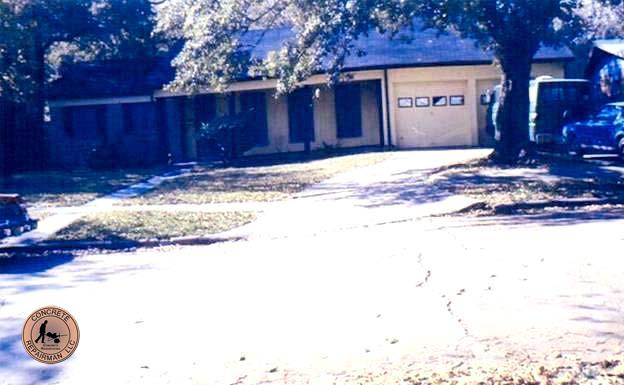
Fault slippage rates in the Houston area vary, with the faster ones moving about 1 inch per year. It has been found that soil and foundations near the active fault line will translate at a rate of 3 vertical to 1 horizontal, meaning that there will be walking in addition to vertical movement.
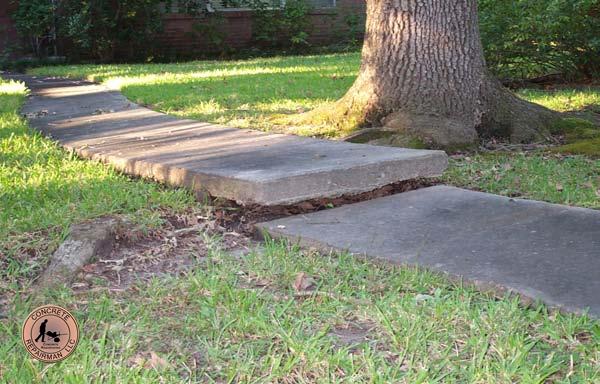
Root heave is another type of movement that can be seen in the flatwork in many areas with mature trees nearby. As the following photo shows, the tree roots can grow under the flatwork, and as the root diameter increases, the flatwork is raised. Reinforcing the flatwork can slow the movement, though a maturing tree is usually able to break up the flatwork.
Root heave in a foundation is less common in the Houston area, because roots require oxygen, and oxygen is not usually plentiful beneath a foundation. One exception occurs when the perimeter grade beam is raised for leveling purposes, as tree roots (and roots of other large vegetation) will grow under the foundation simply because they are able to. If an interior plumbing leak is present, or if the grade slopes towards the house causing water to pond near/under the foundation, then the roots will thrive and extend further under the foundation. This may lead to localized distress.
A second exception is when there are sandy soils with high bearing capacity and good oxygen transmission. In this case the grade beams and walls are typically unaffected, while the slab between the stiffening grade beams exhibits heave-like cracks. The slab movement due to root heave can occur over a short period of time. The following photos depict the diagnosis and remedy of one such case.

A pine tree was growing too close to this house, in an area with sandy soils with high bearing capacity. Due to the high bearing capacity, as the roots grew under the foundation they were unable to fail the soil to expand downward so instead they caused cracks in the slab as they expanded upward.
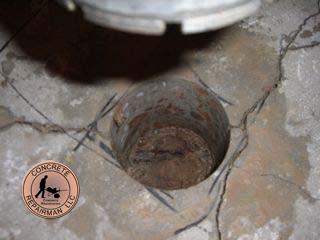
Heave-like slab cracks were visible in the slab. No distress could be seen in the grade beams or superstructure as a result of the tree. A coring was made through the an intersection of the heave-like slab cracks
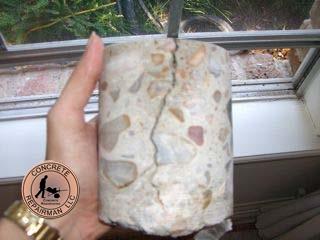
The concrete coring showed a crack that was wider at the top and did not penetrate the entire slab thickness. Were this a crack due to heave, we would expect the crack to penetrate the entire slab and into grade beams.
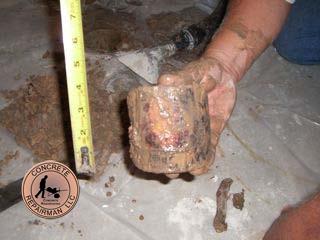
Further coring revealed a portion of tree root. Based on odor and texture, it was determined to be a pine tree root, correlating with the too-close tree seen growing outside.
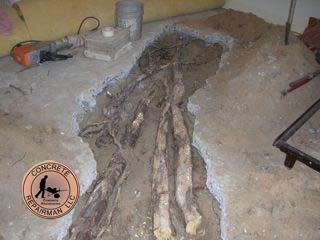
The slab and rebar were removed to expose the root system. The offending tree was just behind the white wall near the top of the photo.
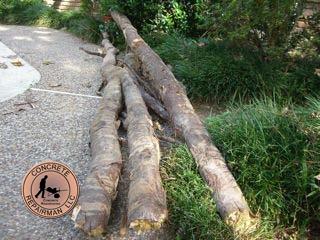
The tree roots were removed.

Select fill was brought in and properly compacted, rebar was replaced, and the slab section was placed.
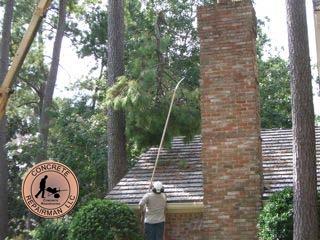
Finally, the offending tree was removed to prevent a repeat performance.
Why Trust Concrete Repairman
James Belville – Foundation Repairman™ – 480-725-7614
At Concrete Repairman LLC, we are proud to be a third generation foundation repair company with over 30 years of hands on experience. Led by James Belville, a master in concrete foundation repair, our team has served homeowners in Phoenix, Arizona, with unparalleled expertise and dedication.
Floor grinding outcomes depend on the right tooling, a controlled approach, and understanding how the surface preparation affects the next finish system. Experience also matters when grinding intersects with broader slab performance concerns such as settlement, cracking, and edge movement.
Concrete Repairman LLC. Roc 300512
Licensed-Bonded-Insured Contractors of Arizona.

What makes the approach dependable
- Surface assessment that matches the grinding plan to the slab condition
- Tooling selection based on grinding goals, leveling, removal, or profiling
- Dust control planning suited to occupied homes and active commercial spaces
- Clear next steps guidance for coatings, overlays, or flooring installation
A Legacy of Excellence in Foundation Repair
With over 30 years of hands-on experience, James Belville and the team at Concrete Repairman LLC have established themselves as trusted experts in foundation repair throughout the Phoenix Metro Area, serving communities like Ahwatukee, Mesa, Chandler, Scottsdale, and beyond. Our reputation for delivering high-quality repair solutions is rooted in our unwavering commitment to excellence, ensuring that every project is completed with the utmost precision and care.
At Concrete Repairman LLC, we pride ourselves on being fully licensed, bonded, and insured, offering peace of mind to homeowners who entrust us with their foundation repairs. Our team of professionals prioritizes safety, quality workmanship, and complete customer satisfaction. We stand behind every repair with industry-leading warranties, demonstrating our confidence in the long-lasting durability of our services. Whether addressing small cracks or more significant foundation issues, we are committed to protecting the integrity of your home.
One of the common issues we encounter in Arizona foundations is efflorescence, a crystalline deposit caused by moisture intrusion. While it may appear harmless initially, efflorescence can be a warning sign of underlying problems such as cracks, stem wall deterioration, or basement moisture. Left unchecked, these issues can lead to significant structural damage. Our team specializes in diagnosing and repairing these moisture-related concerns, offering tailored solutions that prevent further damage and maintain your home’s long-term stability.
At Concrete Repairman LLC, call our Foundation Repair office in the Greater Phoenix Metro Area, including Gilbert, Glendale, Queen Creek, and Sun City. If you suspect foundation damage or want to protect your home from potential issues, contact us at (602) 418-2970. Our expert team is ready to inspect thoroughly and offer the best repair solutions to safeguard your home for years.
