


Page Summary
- Carbon fiber crack stitching depends on epoxy adhesion, surface preparation, and long term bond performance, with delamination and moisture related bond loss as common failure risks.
- Rebar crack stitching provides mechanical anchoring inside the concrete and more predictable strength for tensile, shear, and movement driven stress in slabs on grade and foundation systems.
- Structural crack behavior in Arizona relates to temperature swings and soil conditions, and rebar based stitching is used for higher stress slab and foundation applications.
Carbon fiber reinforcement can be an effective material in the right structural applications, but crack stitching performance depends on how the reinforcement is connected to the concrete and how the repaired area carries load over time. In real concrete slabs and foundation systems, cracks are often driven by movement, moisture changes, temperature swings, and the combined forces that twist and stress the slab. When a repair method relies primarily on surface adhesion, it can fail when the bond line weakens, the substrate is contaminated, or moisture moves through the crack and into the repair interface.
Concrete Repairman LLC performs and evaluates structural crack stitching work across Arizona and compares carbon fiber based crack stitching to rebar based crack stitching for slabs on grade, monolithic foundations, and post tension slab floors. The page content explains why carbon fiber systems can fail in practice and why traditional rebar stitching remains a preferred method for many high stress concrete repairs.
Why Traditional Rebar Methods Still Win
Carbon Fiber vs. Rebar in Structural Crack Stitching
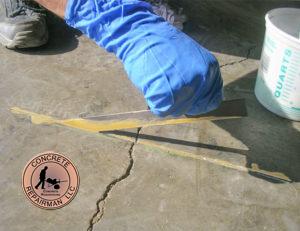
Structural crack stitching using 1/2″ rebar to stabilize concrete cracks in slabs on grade, monolithic foundations, and post-tension slab floors is one of the most reliable repair methods in the industry. While carbon fiber crack repair systems have gained popularity in recent years, a direct comparison shows that rebar stitching delivers significantly greater holding strength and long-term durability.
When comparing the two methods, it becomes clear why foundation repair professionals prefer rebar stitching over carbon fiber. The amount of structural epoxy required to hold carbon fiber in place is more than 10 times less than what is needed in a rebar-based repair. This means the overall structural stability provided by carbon fiber is weaker—especially in high-stress areas or where concrete slabs experience ongoing movement.
Concrete Repairman LLC, a foundation repair contractor in Phoenix, Arizona, has performed extensive testing and real-world installations proving that rebar stitching provides superior results. For homeowners and commercial property owners in Phoenix, Mesa, Tempe, Chandler, Gilbert, Scottsdale, and Glendale, choosing the right repair method can mean the difference between a temporary patch and a permanent fix.
Service Area: Phoenix, Mesa, Tempe, Chandler, Gilbert, Scottsdale, Glendale, in Arizona.
The Limitations of Carbon Fiber in Foundation Repair
While carbon fiber is lightweight and resistant to corrosion, its application in crack stitching has major drawbacks. For example, carbon fiber relies heavily on epoxy adhesion to bond to the concrete surface. If the epoxy fails due to moisture intrusion, poor installation, or surface contamination, the entire repair can fail.
Additionally, carbon fiber lacks the deep anchoring capacity of rebar, which penetrates into the concrete and mechanically locks into place. This deep embedding allows rebar stitching to distribute stress more evenly across the repaired area, reducing the risk of recurring cracks.
In areas like Arizona where temperature fluctuations and expansive soils put additional strain on concrete foundations, a repair method must be able to withstand both tensile and compressive forces. Carbon fiber repairs often address tensile strength but fall short in handling compressive and shear forces, which are critical in preventing future structural failures.
Data from Montana State University
Research from Montana State University provides valuable insight into the performance differences between glass and carbon laminates. According to the DOE/MSU Database, the compressive strengths and strains to failure for various fabrics reveal a major concern: waviness in fiber structure drastically reduces performance.
For example, the A130 glass fabric, with a fiber volume fraction of 43%, experienced a nearly 50% drop in compressive strength compared to a straight-fiber design. This waviness is often unavoidable around flaws or structural details, meaning that carbon fiber repairs may not perform as consistently in real-world conditions as they do in lab testing.
This kind of structural inconsistency is not present in rebar stitching. Rebar’s strength is uniform and predictable, making it a more dependable reinforcement for critical structural repairs.
Grade #60 Rebar Minimum Yield Strength
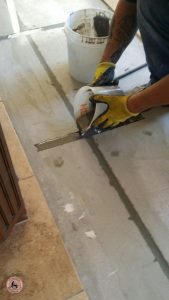
The minimum yield strength of standard rebar in the US is 60,000 psi. This means that the bar can have a yield strength greater than that but never less. For example, #3 rebar has a minimum yield strength of 6,600 pounds. The minimum yield strength of #4 rebar is (11,780 lbs.) 78% greater. The concrete will break before the steel, ensuring the best slab stitching possible.
Reinforcing bar is used to add tensile strength to concrete. The compressive strength of concrete is ten times the tensile strength. That means it takes ten times the weight, or force, to crush concrete than it does to pull it apart. In reality, concrete is not pulled apart by natural forces. Rather, pressure torques and twists concrete. Torque snaps concrete with weak tensile strength. Cracks in concrete are, more often than not, a symptom of this snapping action, a result of concrete’s weak tensile strength.
Compressive versus tensile strength is best illustrated by a spring. A spring can support a tremendous load when weight is applied to one end of the spring’s cylinder or the other. Once compressed to its maximum, a spring becomes extremely resistant to pressure. It is very difficult to crush a spring when force is applied from one end toward the other. However, if one end of the spring’s cylinder is secured in place and pressure is applied laterally to the opposite end of the spring, the coils provide very little resistance.
A spring can be bowed into a U shape with very little force. Concrete is weak in the same respect. It is ten times easier to break concrete by bowing it than by crushing it. However, if rods are welded to the spring cylinder lengthwise, bending the spring using lateral force is much more difficult. Rebar provides the same structural integrity for concrete. It is the necessity of tensile structural integrity — or the lack of the need for it — that determines what rebar sizes are required for a concrete job.
Tensile vs. Compressive Strength in Concrete Repairs
Concrete has a high compressive strength but a relatively weak tensile strength. In fact, it takes roughly ten times more force to crush concrete than to pull it apart. This is why cracks form when a concrete slab is bent, twisted, or subjected to uneven pressure.
A helpful analogy is to think of a coil spring. When compressed end-to-end, the spring can handle tremendous weight. However, if you try to bend it sideways, it becomes much easier to deform. Rebar acts like a set of steel rods welded along the length of the spring—it resists bending and adds significant tensile capacity to the structure.
Without tensile reinforcement like rebar, concrete is vulnerable to cracking under lateral or twisting forces. This is exactly why rebar crack stitching is so effective—it addresses concrete’s weakest point directly.
Why Rebar Stitching Outperforms Carbon Fiber in the Long Run
- Deeper Anchoring – Rebar penetrates into the concrete slab, providing mechanical lock-in, whereas carbon fiber is surface-applied.
- Greater Load-Bearing Capacity – Steel rebar can handle higher tensile forces without relying solely on adhesives.
- Better for High-Stress Applications – In driveways, commercial slabs, and industrial flooring, rebar’s strength is unmatched.
- Long-Term Durability – Carbon fiber can delaminate or lose adhesion, but rebar remains structurally engaged for decades.
When it comes to repairing cracks in slabs on grade, monolithic foundations, and post-tension slabs, the choice between carbon fiber and rebar should be made with long-term performance in mind. While carbon fiber may seem like a modern, high-tech option, rebar crack stitching offers a time-tested, proven solution that withstands Arizona’s challenging soil and climate conditions.
If you want a structural repair that lasts decades rather than years, Grade #60 rebar crack stitching is the clear choice.
FAQs About Structural Concrete Crack Stitching
Why Trust Concrete Repairman
James Belville – Foundation Repairman™ – 480-725-7614
At Concrete Repairman LLC, we are proud to be a third generation foundation repair company with over 30 years of hands on experience. Led by James Belville, a master in concrete foundation repair, our team has served homeowners in Phoenix, Arizona, with unparalleled expertise and dedication. Floor grinding outcomes depend on the right tooling, a controlled approach, and understanding how the surface preparation affects the next finish system. Experience also matters when grinding intersects with broader slab performance concerns such as settlement, cracking, and edge movement.
Concrete Repairman LLC. Roc 300512 Licensed-Bonded-Insured Contractors of Arizona.

A Legacy of Excellence in Foundation Repair
With over 30 years of hands-on experience, James Belville and the team at Concrete Repairman LLC have established themselves as trusted experts in foundation repair throughout the Phoenix Metro Area, serving communities like Ahwatukee, Mesa, Chandler, Scottsdale, and beyond. Our reputation for delivering high-quality repair solutions is rooted in our unwavering commitment to excellence, ensuring that every project is completed with the utmost precision and care.
At Concrete Repairman LLC, we pride ourselves on being fully licensed, bonded, and insured, offering peace of mind to homeowners who entrust us with their foundation repairs. Our team of professionals prioritizes safety, quality workmanship, and complete customer satisfaction. We stand behind every repair with industry-leading warranties, demonstrating our confidence in the long-lasting durability of our services. Whether addressing small cracks or more significant foundation issues, we are committed to protecting the integrity of your home.
One of the common issues we encounter in Arizona foundations is efflorescence, a crystalline deposit caused by moisture intrusion. While it may appear harmless initially, efflorescence can be a warning sign of underlying problems such as cracks, stem wall deterioration, or basement moisture. Left unchecked, these issues can lead to significant structural damage. Our team specializes in diagnosing and repairing these moisture-related concerns, offering tailored solutions that prevent further damage and maintain your home’s long-term stability.
At Concrete Repairman LLC, call our Foundation Repair office in the Greater Phoenix Metro Area, including Gilbert, Glendale, Queen Creek, and Sun City. If you suspect foundation damage or want to protect your home from potential issues, contact us at (602) 418-2970. Our expert team is ready to inspect thoroughly and offer the best repair solutions to safeguard your home for years.
